
Everyday Tokyo Scenes to Walk Before and After Street Kart: Shinagawa, Akihabara, Shibuya, and Shinkiba with Travel Companions Who Move at Different Paces
Everyday Tokyo Scenes to Walk Before and After Street Kart: Shinagawa, Akihabara, Shibuya, and Shinkiba with Travel Companions Who Move at Different Paces
Most people have seen the Rainbow Bridge and the Shibuya Scramble Crossing in photos at least once.
But when you get home from a trip, the things your companions talk about most happily are often the scenes they saw on the way there. A shopfront in a shopping street. Stone steps leading up to a shrine. Someone walking their bicycle in front of the station.
If you'll be in Tokyo for about a week, why not spend some of that time on the "ordinary Tokyo" that lies between the famous sights?
Between the Sights, Your Companions React Differently
When you travel with a group of mixed ages and energy levels, people don't react the same way even when they're standing in the same spot.
People in their twenties get excited under the giant billboards. People in their seventies look a little worn out just from seeing the crowds.
Neither of them is wrong. They just move at different paces. That's all.
To be honest, this is the hardest part of planning a trip. Famous places are crowded, and not everyone will enjoy them with the same enthusiasm.
But turn onto a street one block away from a famous spot, and there's a moment when the air suddenly relaxes.
Laundry hanging on balconies. Shopkeepers chatting out front. Office workers ducking under a noren (a cloth curtain hung at a shop's entrance) at lunchtime.
For people who live in Japan, these are familiar sights. For someone visiting Tokyo for the first time, they become moments where you feel that people really do live their daily lives in this city. And on streets like these, fast walkers and slow walkers can see the same things at their own pace.
Using the areas around Street Kart's Tokyo locations as examples, this article looks at the everyday scenes you can find between the famous sights, and at how to spend time with companions who move at different paces.
One thing first: Street Kart tours are led by a guide, and each location has a set course. If you want time to walk slowly and look around, plan it before or after your tour.
There are 9 locations nationwide (7 in Tokyo, 1 in Osaka, and 1 in Okinawa). Of the 7 in Tokyo, though, Akihabara Store 1 and Store 2 are almost in the same place, and so are the Shibuya store and Shibuya Annex. When planning, it's simpler to think about which area each one is near than about how many locations there are.
Shinagawa: Your Companions' Paces Show at the Foot of the Stone Steps
People often picture the Shinagawa area as the high-rise office district in front of the station. Near the store, though, the neighborhood looks completely different.
Start with Shinagawa Shrine, about a 5-minute walk from the store. It's one of the Tokyo Jissha (ten major shrines of Tokyo), with stone steps, a torii gate, and a Fujizuka (a small mound of earth built to imitate Mt. Fuji) on the grounds.
The reactions in your group will probably split clearly at the foot of these steps.
Younger people will run straight up. Those worried about their knees will stop and look up.
There's no need for everyone to climb. Those who want to can go up while the others wait at the bottom. Bow lightly in front of the torii and watch the climbers go. That still counts as really experiencing the place.
For those who prefer somewhere quieter, Honsenji Temple is about a 10-minute walk away. It's one of the Edo Roku Jizo (six Jizo statues of Edo) and has a large temple bell (daibonsho) designated as a Tangible Cultural Property of Tokyo. On the grounds of this temple, which is more than 1,200 years old, time will seem to pass differently than in front of the busy station.
The easiest place to get a sense of everyday life in this area is the Kita-Shinagawa Shopping Street. It's an old-fashioned shopping street where locals do their daily shopping.
It isn't a street designed for tourists. Walk slowly so you don't get in the way of commuters and shoppers. When passing someone in a narrow spot, say "Sumimasen, toorimasu" (excuse me, coming through). That's all you need. It's much more pleasant than silently turning sideways.
If someone in your group has trouble walking, choosing the right station helps. Kita-Shinagawa Station on the Keikyu Main Line is about a 3-minute walk from the store. From Shinagawa Station, it's about a 10-minute walk.
If you want to go on to Tennozu Isle along the canals after your tour, it's about a 20-minute walk. Some people enjoy a 20-minute stroll. For others, that alone uses up a day's energy. Decide whose pace you'll follow before you set out, and you won't argue about it later.
Highlights on the Shinagawa store's route include the Takanawa area with its historic temples and embassies, the waterfront office district of Shibaura and Tamachi, the Rainbow Bridge as seen from the Shinagawa side, and Tokyo Tower in the distance.
The low roofs of the shopping street you walked through, and the bay views you look up at from the kart. Within a single day, Tokyo's scale changes completely. That's what makes it fun.
Akihabara: One Street Off the Electric Town, Your Companions Relax
Akihabara Electric Town spreads out right around the store: Yodobashi Camera Akihabara, Radio Kaikan, Animate Akihabara. Colors and sounds from the signs come rushing at you all at once.
Some people get excited. Others are worn out by all that information. Both are natural reactions.
That's why we recommend Kanda Myojin Shrine, about a 10-minute walk from the store. Known as the guardian shrine of Edo, it has 1,300 years of history.
Walk just a little way from the electric town, and the noise drops sharply. The wind that blew between the buildings feels a little different once you step onto the shrine grounds. It's easy to picture someone who looked tired in the electric town finally taking a deep breath here.
If it's mealtime, nearby options include the long-established soba restaurant Kanda Yabusoba, about a 15-minute walk away, and Tonkatsu Marugo, about a 10-minute walk away. Soba isn't heavy, so it works well for a group whose appetites and tastes differ.
In Japan, nobody minds if you slurp your noodles. For companions who aren't used to it, a quick "It's fine to do that here" can make mealtime much more relaxed.
For a break, there's a Veloce café about a 3-minute walk away and Starbucks Akihabara Ekimae about a 2-minute walk away. For stations, Suehirocho Station on the Tokyo Metro Ginza Line is about 3 minutes on foot, and Akihabara Station, served by JR and other lines, is about 5 minutes on foot.
Highlights on the Akihabara stores' routes include Tokyo Station, known for its red-brick Marunouchi building; Ginza, home to the Wako clock tower and the Kabukiza Theatre; and the area around Kanda Myojin and Ochanomizu, a student district home to Holy Resurrection Cathedral (Nikolai-do).
A station building that opened in 1914, a shopping district that dates back to the Meiji era, and the back alleys of the electric town you walked through. In one day, it feels like moving back and forth across about 100 years of Tokyo.
Shibuya and Shinkiba: A City of Crowds and a Warehouse District with a Sea Breeze
In Shibuya, Consider Using the Next Station Over
Highlights on the routes from the Shibuya store and Shibuya Annex include the Shibuya Scramble Crossing, Takeshita Street in Harajuku, and Omotesando with its rows of zelkova trees. In terms of crowds, this is one of the busiest parts of Tokyo.
For people who don't like crowds, changing trains at Shibuya Station can be quite an ordeal.
So it's worth knowing about Shinsen Station, one stop from Shibuya on the Keio Inokashira Line. The store is about a 5-minute walk from there, so you can arrive without going through Shibuya Station (which is about a 10-minute walk away).
You might think, "Why bother with a different station?" But the crush of people when you stand on the platform is completely different. For a group with different energy levels, this small extra step pays off more than you'd expect.
If you want some greenery before or after your tour, Yoyogi Park and Meiji Jingu Shrine are both about a 20-minute walk away. Walking through a forest in the middle of the city is a nice contrast to the crowds at the crossing. If anyone in your group loves ramen, Dogenzaka Ramen Yokocho, about an 8-minute walk away, is another option.
In Shinkiba, You Can Smell the Warehouses and the Sea
Shinkiba, home to the Tokyo Bay store, is a bayside area of sea, warehouses, and modern buildings. It's less a tourist spot than a place where people work. Sea breezes blow between the large buildings.
The more you've gotten used to busy famous sights, the more refreshing this "nothing much here" feeling may be.
The nearest station is Shin-Kiba Station (JR Keiyo Line, Tokyo Metro Yurakucho Line, and Rinkai Line), about an 8-minute walk from the store. There's a café-restaurant called CASICA near the station, which is perfect if you want to take a break as soon as you arrive.
If any companions aren't joining the tour and want to do something else, Kasai Rinkai Park, about 15 minutes away by car, is an option. It's a large park facing Tokyo Bay, with a giant Ferris wheel and the Tokyo Sea Life Park aquarium.
Highlights on the Tokyo Bay store's route are the 798-meter-long Rainbow Bridge, the Odaiba area, and the 333-meter-tall Tokyo Tower. Take in the quiet of the warehouse district on foot, then head out to the waterfront by kart. It's the same Tokyo Bay, but it will look like a completely different city.
Who Rides and Who Doesn't: Check the Requirements First
This may be the most important part. If you're traveling with a group of mixed ages and energy levels, not everyone will necessarily be able to ride a kart.
This article won't give definitive answers about age requirements or driver's license requirements. What you need to check depends on the license you hold, and the requirements may change. Before you go, have each person check the latest requirements on the Street Kart official website.
Also, each person drives their own kart, and passengers aren't allowed.
That means your group may end up with some people who ride and some who don't. If you plan around that from the start, you won't be caught off guard on the day.
This is where the places around each store come in handy for those who don't ride. In Shinagawa, they can wait at Starbucks Shinagawa Grand Commons, about a 5-minute walk away. In Akihabara, they can walk to Kanda Myojin and back.
While the riders are out on the tour, the others enjoy Tokyo at their own pace. Then everyone meets up afterward and talks about what they saw. This kind of arrangement works out pretty well.
A few practical details: every store has a restroom and Wi-Fi, and there's a convenience store within a 5-minute walk. For older companions, just knowing where the restroom is ahead of time can be a big relief.
The stores don't have parking. Please use public transportation. Even if you're planning to get around Tokyo by rental car, take the train on this day.
Pay attention to the weather and season, too. Tokyo summers are very hot, so if your group has different energy levels, it's safest to plan for plenty of breaks for both riders and non-riders. Check the official website for how rain and bad weather are handled.
During the tour, follow the instructions of the guide leading the group. Don't use your phone while driving. We completely understand wanting to take photos, but save that for before or after the tour.
What Makes Street Kart Appealing
Since this article has mostly been about the in-between places, here's a little about the karts themselves.
First, a guide leads the way. Participants drive behind a trained guide. You won't be finding your own way through an unfamiliar city.
Second, the language of guidance. On the day of the tour, guidance is generally in English. Guidance in Japanese or other languages depends on the staff on duty, so it can't be guaranteed. If you'd like a language other than English, ask in advance through the official website.
Third, the website is available in 22 languages. Check the official website for which languages are supported. This is separate from the guidance on the day, but it's a nice plus for people who like to know what's going to happen ahead of time.
Fourth, each store has a set course. The scenery you see depends on which store you choose. Picking one in an area near your hotel or your sightseeing plans is one way to decide.
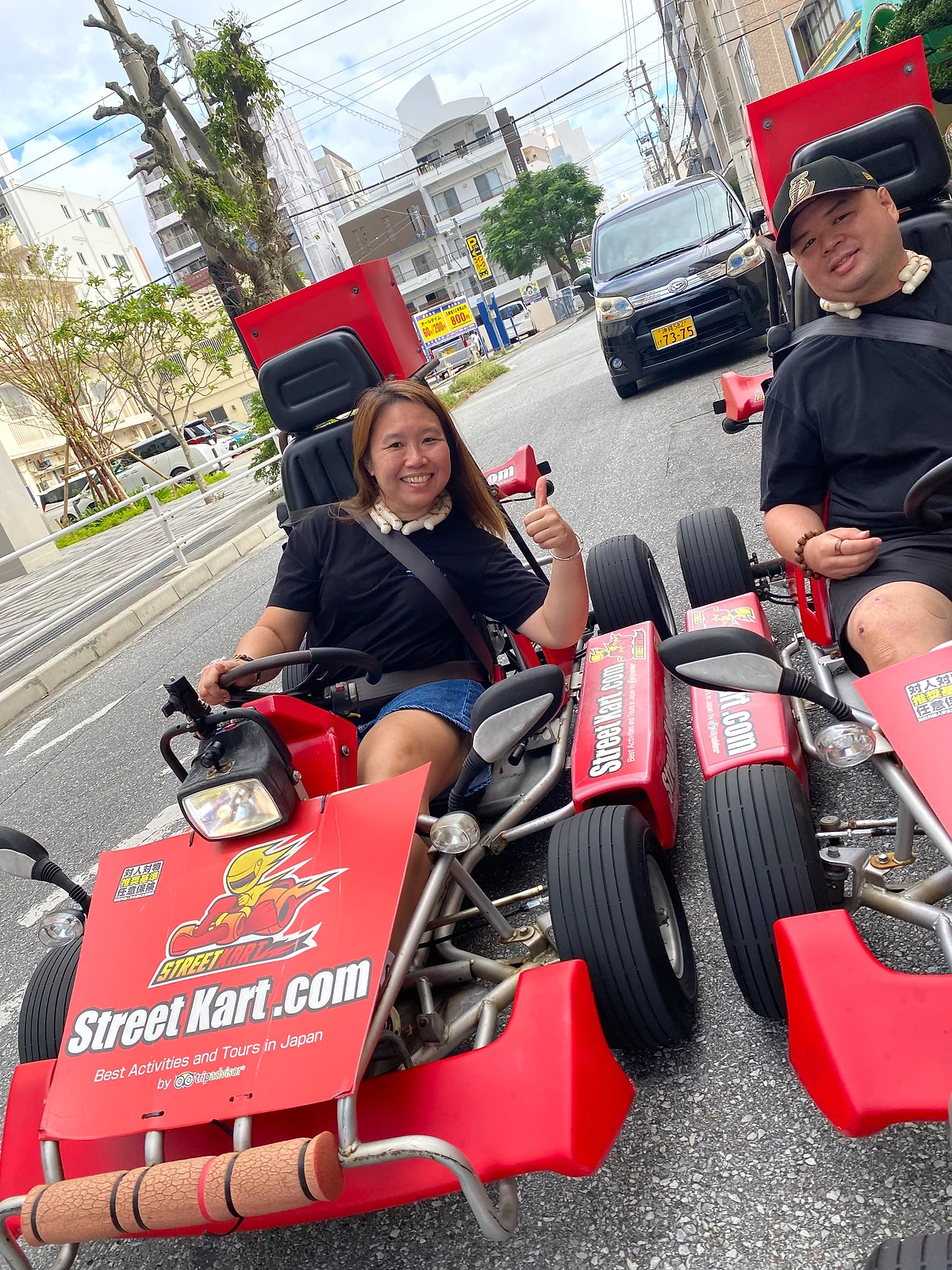
Fifth, the feel of the ride itself. When you grip the wheel of a small kart, the city breeze hits your hands directly. A bus stopped next to you at a red light looks as tall as a wall. The sky above the buildings feels wider than usual. Tokyo flows past at a height that's different from both the everyday scenes you saw on foot and the view from a train window.
Finally, its track record. As of November 2023, across all stores, there had been more than 150,000 tours, more than 1.34 million customers, and more than 20,000 reviews, with an average rating of 4.9 out of 5.0. These are slightly older figures, not current ones, but they give you a sense of how many people have taken part.
Things to Talk About with Your Companions Before Booking
Bookings are accepted via Facebook, LINE, and email. Check the official website for detailed steps.
Weekends tend to book up quickly, so if you want to ride on a weekend, act early. If you'll be staying for a week or more, thinking first about whether you can fit it in on a weekday gives you more options.
Before booking, it helps to talk about just three things with your companions:
Who will ride? Where will those who don't ride wait? How much can everyone walk before and after the tour?
Once these three are decided, which area's store to choose will follow naturally.
Seeing famous sights is, of course, an important part of any trip. But years later, what you remember may be the time spent waiting at the foot of the stone steps, or the steam rising beyond the noren of a soba shop.
Tokyo by kart and Tokyo on foot. Try making a plan where everyone can take home both, each at their own pace. You can check participation requirements and the latest information on the Street Kart official website.
This article was originally written in Japanese and translated using AI. Some expressions may read unnaturally, and we appreciate your understanding. For the most accurate and up-to-date information, please refer to the official site at kart.st.
Street Kart is not affiliated with Nintendo or the Mario Kart series in any way. We do not provide costumes of Nintendo characters, and such costumes may not be worn during tours even if brought by participants.