
Morning or Evening for Your Second Tokyo Street Kart Ride? How the City Changes, and How Everyone in Your Group Can Spend the Time
Morning or Evening for Your Second Tokyo Street Kart Ride? How the City Changes, and How Everyone in Your Group Can Spend the Time
If you've ridden once, you probably remember the nervous feeling before you took the wheel. You also remember how low your eyes were to the ground the moment you pulled away.
So what should you change the second time around?
One answer is the time of day. Even in the same Tokyo, Ginza in the morning and Ginza in the evening feel like two different cities. This article goes store by store to show how the city looks different in the morning and in the evening. Then it covers how to plan a trip with companions of different ages and fitness levels, so that nobody overdoes it, whether they drive or not.
You Notice Different Things the Second Time
Most first-ride memories boil down to "I did it!" The open-top body. The low seat. The engine vibration and the noise of the city coming straight into your body. Looking up at the bus that pulls up next to you at a red light. Anyone who has ridden will remember these feelings.
The interesting part comes after that.
By the second ride, you're used to the vehicle, so you have room to look around. The first time, you could barely do more than follow the kart in front of you through the intersections. This time you start to notice the angle of the light on the building walls, and even the colors of the clothes people are wearing on the sidewalk.
That's why it's worth choosing your second ride by asking, "What time of day do I want to see the city?"
One thing to know first: Street Kart is a guided tour, and the route for each course is fixed. What you get to choose is when you ride, which store you start from, and where you spend your time before and after. Check which time slots are available on the official website before you book.
Morning and Evening, Store by Store
Akihabara Stores (Store 1 and Store 2): Red Brick and the Ginza Clock Tower
Tours from the Akihabara stores include courses that pass Tokyo Station's Marunouchi building and Ginza.
Tokyo Station is a red-brick station building that opened in 1914. Early in the day, that red seems to float softly in the gentle light. From the low seat of a kart, you look up at the front of this Important Cultural Property, at an angle steep enough to strain your neck a little.
Ginza changes even more clearly. Early in the day, Chuo-dori is quiet, as if the whole district is still getting ready. By evening, more lights come on around the Wako clock tower, and light from the shop windows spills onto the sidewalk. At the same 4-chome intersection, the morning is about looking at buildings and the evening is about looking at light.
The same goes for Akihabara's Electric Town. While it's light out, the colors of the signs look sharp. Once the sun goes down, the signs themselves light up. If your first ride through Akiba was in the evening, try an earlier time for your second. It should feel very different, clear enough that you can read every character on the signs.
By the way, Akihabara Store 1 and Store 2 are almost in the same place. Whichever one you start from, the surroundings feel much the same.
Shibuya Store and Shibuya Annex: The Crowds at the Crossing Change
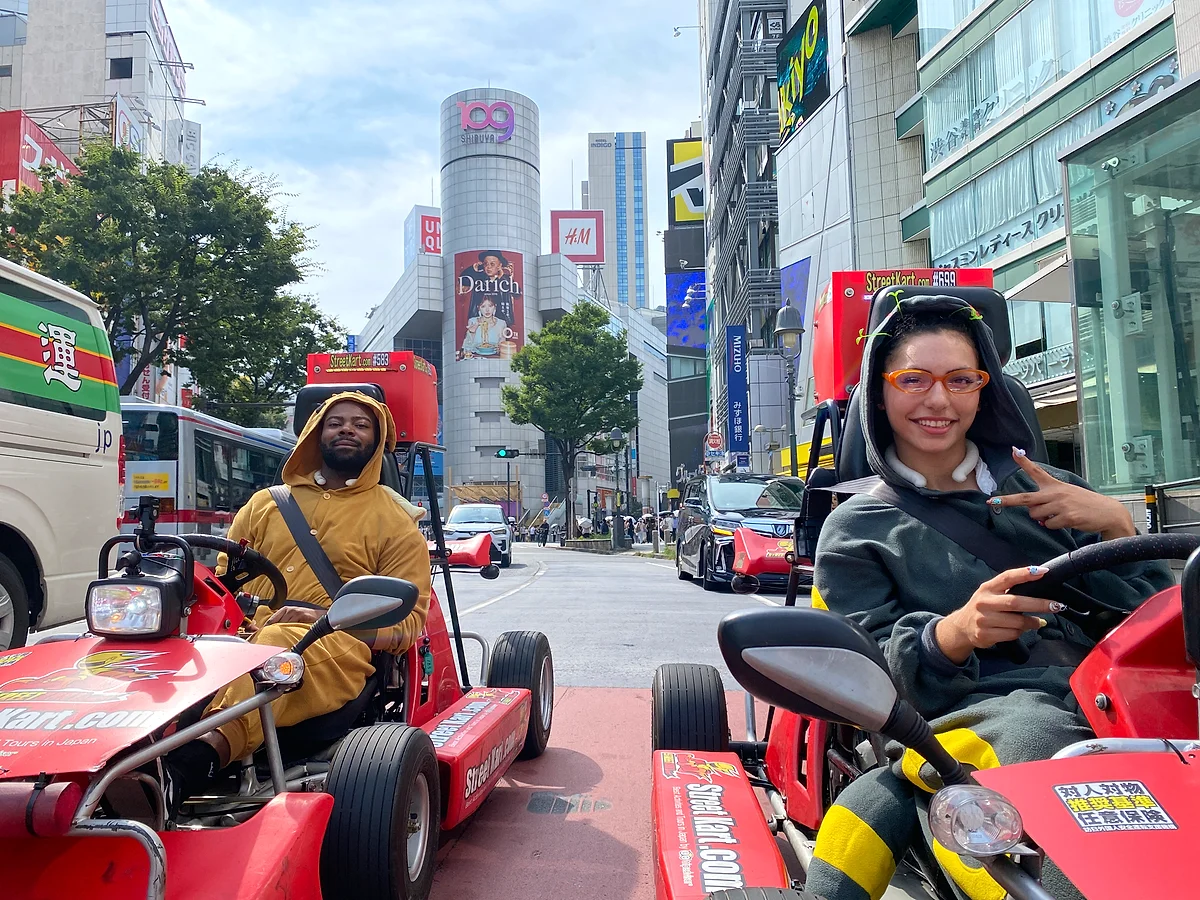
The Shibuya Store and Shibuya Annex are also almost in the same place. The route includes the Shibuya Scramble Crossing, Harajuku's Takeshita Street, and Omotesando.
The interesting thing is that the Scramble Crossing becomes a different place depending on the time of day. Early on, people walk in straight lines and seem fairly orderly. By evening, people meeting friends, shoppers heading home, and tourists taking photos are all mixed together, and the moment the light changes, the crowd spreads out in every direction. You slip past that wave of people with your eyes close to the ground.
The zelkova trees along Omotesando change too. In daylight, the green leaves are bright, and the outlines of the distinctive buildings designed by famous architects stand out clearly. In the evening, with the streetlights and shop lights, the shadows under the trees slowly deepen. If you saw one version on your first ride, see the other on your second. It's the same route, but it'll feel like you drove a different road.
Shinagawa Store: Bayside Skies and Tokyo Tower in the Distance
Highlights of the Shinagawa Store route include the high-rises around Shinagawa Station, the Rainbow Bridge, the Takanawa area, and the Shibaura and Tamachi bay area. You can also see Tokyo Tower in the distance.
On the waterfront, the color of the sky is the star. In daylight, the water shines a pale white, and the sky is reflected in the glass of the office buildings. In the evening, the sky slowly changes color, and lights start to come on in the building windows one by one. Sunset times vary a lot by season, so the trick is to check the sunset time for that time of year and work out what the sky will look like at each time slot.
The Shinagawa Store's S-S course is described as having an evening option with less traffic. If you want to see the evening sky, that's a good place to start. Check on the official website whether the option is available before you book.
Tokyo Bay Store (Shin-Kiba): Sea Breeze and Lights on the Bridge
The Tokyo Bay Store route covers the Shin-Kiba bayside, the Odaiba area, the Rainbow Bridge, and Tokyo Tower.
In daylight, the bay area feels huge. Surrounded by warehouses and the sea, the salty breeze hits you right in the face. After sunset, the 798-meter Rainbow Bridge lights up, and in the distance the 333-meter Tokyo Tower glows red.
If your first ride was in the daytime, I think you'll enjoy choosing something closer to evening for your second. On the other hand, if your strongest memory is the night view, you may be surprised by the bright waterfront, where everything looks sharp and clear.
The Tokyo Bay Store's K-M course is also described as offering night views in its evening slots. If you're aiming for evening, compare the sunset time for that season with the slots you can choose on the official website. Will the sky still be light, or will the bridge already be lit up? Even within "evening," what you see depends on your departure time.
Planning When Your Group Has a Range of Ages and Fitness Levels
In a group with mixed ages and fitness levels, the big question is, "Can everyone ride?"
Honestly, this article can't answer that for you. Drivers must be 18 or older, and there are license requirements. Karts are single-seaters, so passengers aren't allowed. Before you go, have each person check whether their license qualifies on the official driver's license page, and check the other requirements on the official website.
With that in mind, a second visit allows for a different setup. The people who rode last time ride again. Anyone not riding this time spends the time somewhere nearby. Everyone meets up after the tour. This way, nobody who's unsure about their stamina has to push themselves.
Knowing what the vehicle is like also helps people decide whether to ride. The karts have no suspension, so you feel every bump in the road. Riding is not recommended during pregnancy, and pregnant guests are asked to consult a doctor. Anyone with back problems or other health concerns can sit that day out and wait. On a second trip, it's easy to make that kind of choice without pressure.
The stores have no parking, so travel by train or other public transportation. The stores have restrooms and Wi-Fi.
If you ride early, how you spend the time before and after changes completely.
At the Tokyo Bay Store, Toyosu Market is a 10-minute drive away. The market is busiest from early morning through the late morning, so it pairs well with an early ride. People who aren't riding can enjoy a relaxed seafood breakfast and meet up after the tour.
At the Shinagawa Store, Shinagawa Shrine is a 5-minute walk away. It's one of the Tokyo Ten Shrines and has a Fujizuka (a miniature Mount Fuji). There are stone steps, though. If someone in your group has trouble with their legs or back, they might wait at the bottom or just go as far as feels comfortable.
At the Akihabara stores, Kanda Myojin is a 10-minute walk away. It's known as the guardian shrine of all Edo and has 1,300 years of history. For anyone who wants to relax somewhere more spacious, Ueno Park is 5 minutes away by train. With Ueno Zoo, the Tokyo National Museum, and the National Museum of Western Art there, people who aren't riding can pick a place to enjoy at their own pace.
Even early in the day, the summer sun gets strong. The karts have no roof, so bring a hat, sunglasses, and sunscreen. Closed-toe sneakers are recommended, and open-toe shoes and heels should be avoided. Anyone waiting should also wear comfortable shoes if they plan to walk around the market or climb shrine steps.
If you ride in the evening, find a spot where the people waiting can also see the sunset. That way, everyone comes home with the same kind of memories.
At the Shibuya Store and Shibuya Annex, Shibuya Scramble Square and Shibuya Hikarie are both a 10-minute walk away. Shibuya Scramble Square has the Shibuya Sky observation deck, where you can look down on the city in the evening. While the drivers are slipping through the crossing close to the ground, the people waiting are watching the same streets from above. Share photos afterward and you'll have seen the same Shibuya from two angles, below and above. It's a lot of fun. The tour also stops at photo spots along the way, so the drivers will have photos to share too.
At the Shinagawa Store, Tennozu Isle is a 20-minute walk away. Art galleries and cafés line the canals there, and the waterfront has a relaxed feel in the evening. For anyone who doesn't feel like walking, atré Shinagawa is connected directly to Shinagawa Station.
At the Tokyo Bay Store, Odaiba is a 10-minute drive away. Shopping centers like DiverCity Tokyo Plaza and Aqua City Odaiba are good options for spending the waiting time.
In the evening, the wind can feel cold once the sun goes down, so bring a jacket suited to the season. Also decide ahead of time who carries what. The store lockers are for small items and aren't suitable for large luggage like suitcases. The karts can only hold a small bag or so. If the people not driving hold onto the larger bags, the drivers can set off with less to carry.
Weekends tend to fill up, so book early once your dates are set. If the slots fill up while you're waiting to confirm who's coming, your whole time-of-day plan falls apart. Check the official website for how to book.
Cancellation is free up to 7 days in advance. If you're not sure how your companions will be feeling, put that deadline in your calendar. Raincoats are provided for free on rainy days. Tours go ahead as planned in light to moderate rain and are canceled in heavy rain or typhoons. Check the official website for the full policy.
On the day, there's a check-in and a safety briefing, so you're asked to arrive at the store 15 minutes early. Decide where you'll split up with the people waiting, and when and where you'll meet again. If you settle this when you arrive, you won't have to message back and forth hunting for each other after the tour.
Guidance on the day is mainly in English. Guidance in Japanese or other languages depends on the staff working that day and isn't guaranteed. If someone in your group is worried about the language, it's a good idea to ask in advance through the official website. The website itself is available in 22 languages.
Prices vary by season and time of day, so check the official website for the latest information. When you compare morning and evening, rely on the official information at that time, not on this article.
What Makes Street Kart Special: Things You Notice the Second Time
The first time, you're focused on the kart. The second time, you start noticing the small details around you.
One example is the trained guides who lead the tour. On your second ride, you'll have the headroom to notice when the guide gives signals and how they keep an eye on the whole group.
Here are some numbers too. As of November 2023, all stores combined had run more than 150,000 tours, served more than 1.34 million customers, and received more than 20,000 reviews, with an average rating of 4.9 out of 5.0.
What Time of Day Will You Drive Tokyo Next?
Your first Street Kart ride leaves you with a memory of driving through Tokyo.
Your second leaves you with something clearer: driving through Tokyo in the morning, or in the evening.
After five years in Japan, I'm still surprised every time by how much the same intersection changes with the time of day. The hour when light falls on the red-brick station. The hour when shadows spread under the zelkova trees. The hour when lights start coming on in the waterfront buildings.
Once you've decided which version of the city you want to see, think about how your companions will spend their time. Some will drive, and some will wait nearby. If you can plan it so nobody has to push themselves, your second trip to Tokyo will be more relaxed and more fun.
Weekends tend to fill up, so once you have dates in mind, check stores, times, and how to book on the official website, and reserve early.
This article was originally written in Japanese and translated using AI. Some expressions may read unnaturally, and we appreciate your understanding. For the most accurate and up-to-date information, please refer to the official site at kart.st.
Street Kart is not affiliated with Nintendo or the Mario Kart series in any way. We do not provide costumes of Nintendo characters, and such costumes may not be worn during tours even if brought by participants.